

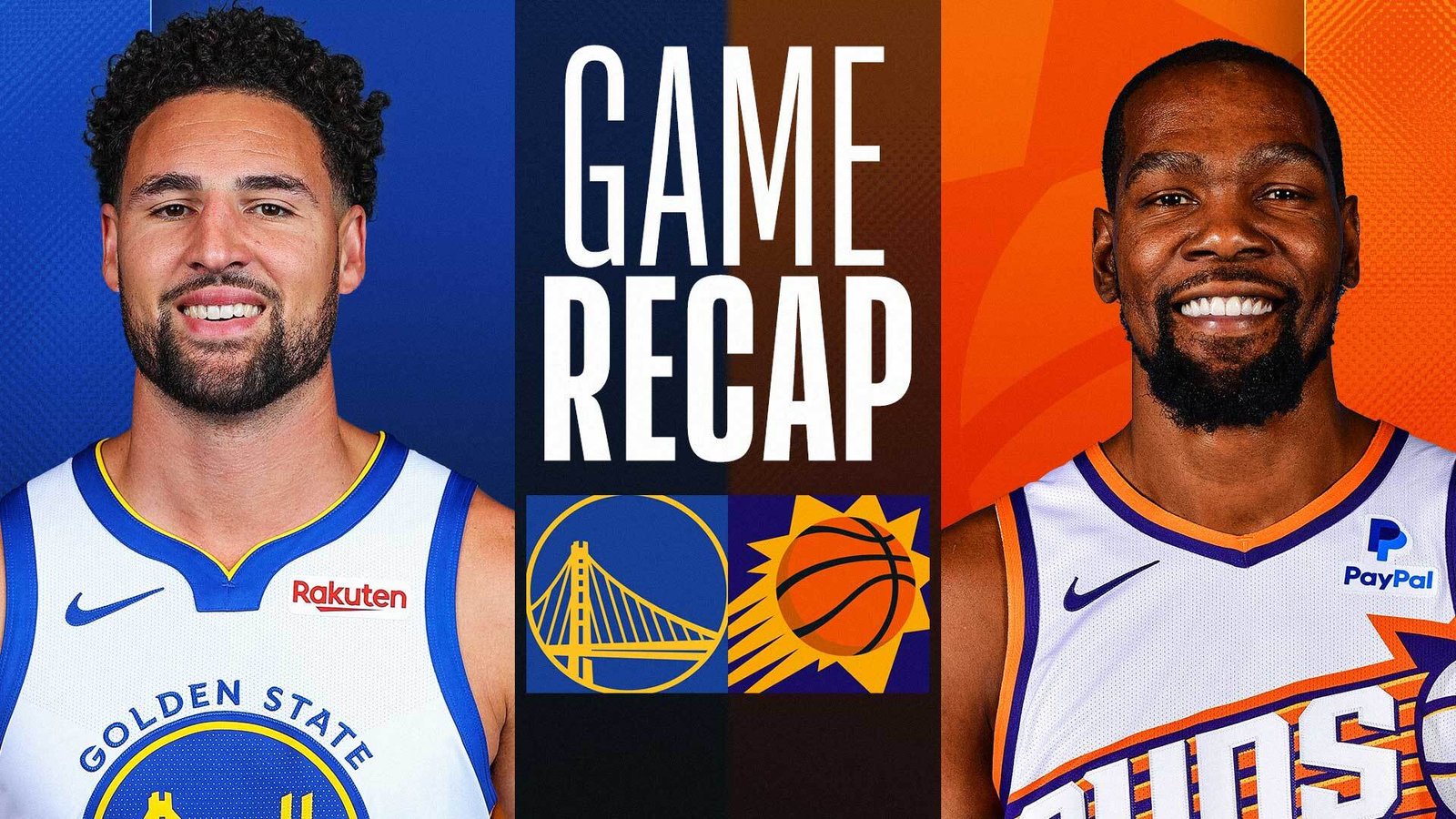
The November 4, 2025, game between the Phoenix Suns and the Golden State Warriors was particularly fierce, a contest between accuracy and tenacity. With the Suns struggling to find rhythm due to injuries and the Warriors showcasing their enduring mastery of movement, space, and timing, both teams had something to prove when they arrived at the Chase Center. Golden State’s 118-107 victory felt especially dominant because it was based on poise, strategy, and an incredible distribution of contributions from all players on the team.
Devin Booker, who scored 38 points with a graceful yet unrelenting energy that seemed to fuel every possession, once again emerged as the center of the Suns’ offense. From the first quarter, his rhythm was very evident as he dribbled past defenders with a dexterity that seemed natural. Each pull-up jumper was deliberate and forceful, landing like punctuation. Although even his accuracy wasn’t enough to completely turn the tide back in Phoenix’s favor, his flawless 11-for-11 performance at the free-throw line represented control in the midst of chaos.
| Category | Details |
|---|---|
| Date | November 4, 2025 |
| Venue | Chase Center, San Francisco, California |
| Attendance | 18,064 |
| Final Score | Golden State Warriors 118 – Phoenix Suns 107 |
| Top Performer (Suns) | Devin Booker – 38 points, 3 rebounds, 4 assists |
| Top Performer (Warriors) | Stephen Curry – 28 points, 4 rebounds, 3 assists |
| Standout Contributor (Suns) | Mark Williams – 16 points, 16 rebounds |
| Standout Contributor (Warriors) | Moses Moody – 24 points, 5 rebounds |
| Reference | NBA Official Box Score: https://www.nba.com/game/gsw-vs-phx-0022500123 |
Playing their fourth game in five cities, Golden State appeared incredibly effective right away. As usual, Stephen Curry used a combination of grace and aggression to control the tempo. His range is still incredibly effective, and he scored 28 points while making five three-pointers. Even after ten years of dominance, the Warriors’ system is still anchored by his unrivaled ability to create shots that seemed unlikely just moments before.
Moses Moody, who played with remarkable poise and confidence, was Curry’s backup. His development was highlighted by his 24 points and five three-pointers, and his timing and positioning showed a growing maturity. Moody’s performance was not only statistically outstanding but also symbolically potent, demonstrating the continued success of Golden State’s development pipeline, which skillfully blends youth and veteran poise.
Mark Williams gave Phoenix one of his most comprehensive performances of the year. With 16 points and 16 rebounds, he significantly enhanced the team’s second-chance attempts by being a vital presence in the paint. In the third quarter, when Phoenix exploded with a 20-6 run that reduced Golden State’s lead to single digits, his rebounding was especially crucial. Williams’ self-control on both ends demonstrated the importance of interior steadiness in a time when dominance of the perimeter is the norm.
Ever the shooter, Grayson Allen scored 16 points, making four of his nine long-range attempts. His three-pointers came at crucial moments when Phoenix sorely needed rhythm, demonstrating his perfect timing. The Suns experienced moments of chemistry, but their defensive communication was lacking. Every missed rotation created a gap, which the Warriors expertly took advantage of.
One of Golden State’s unsung heroes of the evening was Quinten Post. His skill set grew more versatile as he scored 14 points on 5 of 7 shooting, including four from beyond the arc. His versatility was especially helpful in keeping the Warriors bench stable, especially after Jimmy Butler left the game in the first half because of back pain. Instead of making the team uneasy, Butler’s early departure appeared to sharpen everyone’s focus.
With 13 points and four assists, Brandin Podziemski displayed confidence and creative playmaking that belied his age. His easy rapport with Moody and Curry mirrored the team’s focus on selfless basketball, which is a rhythm of trust rather than individuality. With 12 points and three three-pointers, Buddy Hield also contributed significantly off the bench. His shooting was especially successful in keeping Golden State’s lead late in the fourth quarter.
Ever the defensive mastermind, Draymond Green gave a subtle but profoundly impactful performance. The chaos he caused for Phoenix’s offensive sets is hardly indicated by his stat line of 8 points, 10 rebounds, and 9 assists. In ways that statistics cannot adequately convey, his leadership, foresight, and communication on both ends influenced the Warriors’ defensive rhythm. Green used his timing and intelligence to make sure that even when Phoenix gained momentum, their drives encountered well-thought-out opposition.
Booker was brilliant for the Suns, but it became clear that the offensive distribution was unbalanced. Phoenix relied largely on isolation sequences that slowed their tempo because they were missing Dillon Brooks and Jalen Green. Ryan Dunn’s vigor and defensive effort were admirable, but neither could make up for the lack of a reliable backup playmaker. Royce O’Neale contributed eight points and six rebounds.
Golden State continued to have a significantly higher shooting percentage, making 49.4% of their field goals and 45.2% of their three-pointers. With 33 assists as opposed to Phoenix’s 25, their ball movement was extremely effective, demonstrating the cohesive system that has long characterized the Kerr-era Warriors. The Suns, on the other hand, shot 44% overall, with turnovers at pivotal points disrupting their flow.
By the last few minutes, the narrative had shifted from the scoreboard to execution. Curry appeared calm and focused despite being exhausted from a hectic travel schedule. His casually certain deep three in the final minutes sealed the victory and served as a reminder to supporters that despite his increasing athleticism, his intuition is still incredibly keen.
In defeat, Booker’s reaction was just as telling. His body language, concentration, and refusal to give up conveyed the resolve of a player conscious of his team’s incomplete development. Even though it was a big loss, the Suns showed promise in their offensive inventiveness, defensive tenacity, and rebounding that could be improved upon as the season went on.
Beyond its numbers, the game symbolized a conflict between rebuilding and improvement. The Warriors appeared to be a team that was still remarkably resilient in terms of both strategy and spirit, relying on their experience and habit. Younger and less unified, the Suns had the unadulterated ambition of a team discovering what it takes to be consistent.
From a wider angle, this game demonstrated how flexibility and vision continue to influence basketball. Phoenix’s ongoing quest for synergy highlights the difficulty of building around changing stars, while Golden State’s ability to incorporate new players without compromising identity is still remarkably inventive. In their own ways, both teams exemplify the tenacity, creativity, and drive for greatness that characterize contemporary sport.
The scoreboard read 118-107 as the final buzzer rang out through Chase Center, but the significance went well beyond the numbers. Deeply seasoned but still hungry, the Warriors walked off the court feeling like they belonged among the other contenders. Notwithstanding their loss, the Suns offered hints of a time when their group’s rhythm might at last match their abilities.
The most outstanding performances are not always determined by victory alone, but rather by how a team learns, adapts, and evolves together — step by step, possession by possession. This game served as a subtle reminder in a league that is defined by change and competition.
